Age-related hearing loss, known medically as presbycusis, is the most common form of hearing loss in the United Kingdom — and one of the most under-treated health conditions in older adults. It develops gradually over many years as the delicate structures of the inner ear wear down through a lifetime of use, genetics, and environmental exposure. According to the Royal National Institute for Deaf People (RNID), approximately 40 per cent of people over 50 and around 70 per cent of people over 70 have some degree of measurable hearing loss. Yet despite its extraordinary prevalence, presbycusis remains widely dismissed as an inevitable and harmless part of ageing — an attitude that delays diagnosis by an average of ten years and carries serious consequences for cognitive health, mental wellbeing, and independence.
What Is Presbycusis and How Does It Develop?
The inner ear contains approximately 15,000 microscopic hair cells within the cochlea, a snail-shaped organ that converts sound vibrations into electrical signals sent to the brain via the auditory nerve. Over decades of use, these hair cells gradually deteriorate and die. Unlike hair cells in birds and certain reptiles, human cochlear hair cells do not regenerate — once they are lost, the damage is permanent.
The deterioration typically begins with the hair cells responsible for detecting high-frequency sounds, which is why the earliest signs of presbycusis often involve difficulty hearing consonant sounds like “s”, “f”, “th”, and “sh”. These consonants carry the clarity in speech, which explains why someone with early age-related hearing loss can often hear that someone is speaking but cannot make out what they are saying — particularly in noisy environments such as restaurants, family gatherings, or busy shops.
The condition progresses gradually over years and decades. By the time most people notice a significant problem, substantial hearing loss has already occurred. Research from the University of Manchester suggests that the average person waits around ten years from first noticing hearing difficulties to seeking professional help — a delay that has measurable consequences for brain health and quality of life.
How Common Is It? UK Prevalence by Decade
Presbycusis is remarkably common, and its prevalence increases sharply with age. Data from the RNID, NHS England, and peer-reviewed epidemiological studies paint a clear picture:
- Ages 40-49: approximately 8-10 per cent have measurable hearing loss, though most are unaware of it
- Ages 50-59: around 25-30 per cent have some degree of hearing loss, primarily in the high frequencies
- Ages 60-69: approximately 40-45 per cent are affected, with a growing impact on speech comprehension
- Ages 70-79: around 65-70 per cent have clinically significant hearing loss
- Ages 80+: over 80 per cent have hearing loss, with many experiencing moderate to severe impairment
In total, the RNID estimates that around 12 million adults in the UK have hearing loss — a figure expected to rise to 14.2 million by 2035 as the population ages. Despite these numbers, only around two million people in the UK currently use hearing aids, leaving millions with untreated hearing loss and its associated risks.
The Role of Genetics and Lifestyle
While ageing is the primary driver of presbycusis, the rate and severity of hearing loss are influenced by a complex interplay of genetic and environmental factors:
- Genetics: twin studies and family research indicate that hereditary factors account for approximately 35-55 per cent of the variation in age-related hearing loss. If your parents or siblings experienced hearing loss in later life, you are statistically more likely to as well
- Cumulative noise exposure: a lifetime of noise exposure — from work, music, traffic, and recreational activities — accelerates the natural deterioration of hair cells. Many cases of presbycusis have a noise-induced component
- Cardiovascular health: the cochlea depends on a rich blood supply. Conditions that affect circulation — including hypertension, atherosclerosis, and diabetes — are associated with more rapid hearing decline. A 2019 study published in the American Journal of Audiology found that adults with cardiovascular disease were 54 per cent more likely to have hearing loss
- Ototoxic medications: certain medications, including some antibiotics (aminoglycosides), chemotherapy drugs (cisplatin), and high-dose aspirin, can damage cochlear hair cells and accelerate hearing loss
- Smoking: research consistently links smoking to increased risk of hearing loss, likely through its effects on blood flow to the inner ear. A meta-analysis published in JAMA Otolaryngology found that current smokers had a 70 per cent higher risk of hearing loss compared to non-smokers
Understanding these risk factors matters because some are modifiable. Protecting your hearing from excessive noise, managing cardiovascular health, and not smoking can all help to slow the progression of age-related hearing loss.
Recognising the Signs and Symptoms
Presbycusis develops so gradually that many people do not recognise it in themselves. It is often family members, friends, or colleagues who notice the changes first. The most common signs include:
- Difficulty following conversations in noisy settings — restaurants, family gatherings, and social events become increasingly challenging
- Frequently asking people to repeat themselves — or responding inappropriately because you misheard what was said
- Turning the television up louder than others find comfortable
- Struggling to hear women’s and children’s voices — higher-pitched voices are harder to distinguish as high-frequency hearing declines
- Missing doorbells, phone ringtones, or alarms — many alert sounds are pitched in the higher frequencies
- Feeling that people mumble — this is a hallmark of high-frequency loss, where vowel sounds (which carry volume) are heard but consonants (which carry clarity) are missed
- Tinnitus — ringing, buzzing, or hissing in the ears frequently accompanies age-related hearing loss and affects an estimated 7.1 million people in the UK
If you recognise any of these signs in yourself or a family member, a hearing test is the logical next step. Early detection does not reverse the damage, but it opens the door to treatment that can make a transformative difference to daily life.
Ready to get your hearing checked?
Enter your postcode to compare audiologists and book today.
Find appointments →The Cognitive Link: Hearing Loss and Dementia
Perhaps the most compelling reason to address presbycusis promptly is the growing body of evidence linking untreated hearing loss to cognitive decline and dementia. The 2020 Lancet Commission on Dementia Prevention, Intervention, and Care identified hearing loss in midlife as the single largest modifiable risk factor for dementia — accounting for approximately 8 per cent of all cases, more than smoking, hypertension, depression, or physical inactivity.
Research led by Professor Frank Lin at Johns Hopkins University found that adults with mild hearing loss had nearly double the risk of developing dementia, with the risk tripling for moderate hearing loss and increasing fivefold for severe hearing loss. In the UK, a landmark study published in The Lancet Public Health in 2023, using data from the UK Biobank involving nearly 440,000 participants, found that hearing aid use was associated with a 42 per cent reduction in the risk of all-cause dementia.
The ACHIEVE trial, a randomised controlled trial published in The Lancet in 2023, provided the strongest evidence to date that hearing intervention can slow cognitive decline in older adults at elevated risk. Participants who received hearing aids and audiological counselling showed a 48 per cent reduction in the rate of cognitive decline over three years compared to the control group.
Researchers have proposed several mechanisms for this connection. The cognitive load hypothesis suggests that when the brain must work harder to decode degraded auditory signals, fewer resources remain for memory and executive function. The social isolation pathway recognises that hearing loss drives withdrawal from conversation and social activity — itself a well-established dementia risk factor. And neuroimaging studies have shown that untreated hearing loss is associated with accelerated atrophy of the temporal lobe, the brain region critical for hearing, speech comprehension, and memory.
Treatment Options: NHS and Private
While presbycusis cannot be reversed, it is highly treatable — and the treatment is remarkably effective. Hearing aids are the primary intervention, and for the vast majority of people with age-related hearing loss, they deliver a significant improvement in communication, confidence, and quality of life.
NHS hearing services: The NHS provides hearing aids completely free of charge, including fitting, batteries, repairs, and ongoing aftercare. Access is typically through a GP referral to an NHS audiology department, though some areas allow self-referral. The NHS primarily offers digital behind-the-ear (BTE) hearing aids, which are clinically effective and suitable for most types of hearing loss. Waiting times vary by region but are typically four to twelve weeks.
Private hearing services: Private audiologists — including Boots Hearingcare, Specsavers Audiology, and independent practices — offer a wider range of hearing aid styles and technology levels. Options include discreet receiver-in-canal (RIC) devices, completely-in-canal (CIC) models, and invisible-in-canal (IIC) hearing aids. Prices typically range from £1,000 to £7,000 per pair, depending on the technology level and features. Private appointments are usually available within days rather than weeks.
Understanding Modern Hearing Aids
If your perception of hearing aids is shaped by memories of large, beige, whistling devices, the reality of modern hearing technology may surprise you. Today’s hearing aids are sophisticated digital devices that bear little resemblance to their predecessors:
- Size and discretion: many modern hearing aids are virtually invisible, sitting deep in the ear canal or tucked behind the ear with a thin wire
- Bluetooth connectivity: most current hearing aids connect directly to smartphones, televisions, and other devices, streaming phone calls, music, and audio content directly to your ears
- Rechargeable batteries: many models now use lithium-ion batteries that charge overnight in a compact case, eliminating the need to change tiny disposable batteries
- AI-powered processing: advanced hearing aids use artificial intelligence to analyse the listening environment in real time, automatically adjusting settings for speech in quiet, speech in noise, music, wind, and other scenarios
- Telecoil compatibility: hearing aids with telecoils can connect to hearing loop systems installed in theatres, cinemas, churches, banks, and public buildings across the UK, delivering sound directly without background interference
- Tinnitus masking: many hearing aids include built-in tinnitus relief features that play soothing sounds to help manage the ringing or buzzing that often accompanies presbycusis
For a deeper understanding of how to navigate the range of options, our guide to choosing hearing aids covers styles, technology levels, and what to consider when making your decision.
When and How to Get Tested
If you are over 50 and have not had your hearing checked — or if you have noticed any of the signs described above — arranging a hearing test should be a priority. The NHS recommends that adults have their hearing tested if they notice any change, but many audiologists and hearing charities advocate for routine screening from the age of 55, given the strong link between untreated hearing loss and cognitive decline.
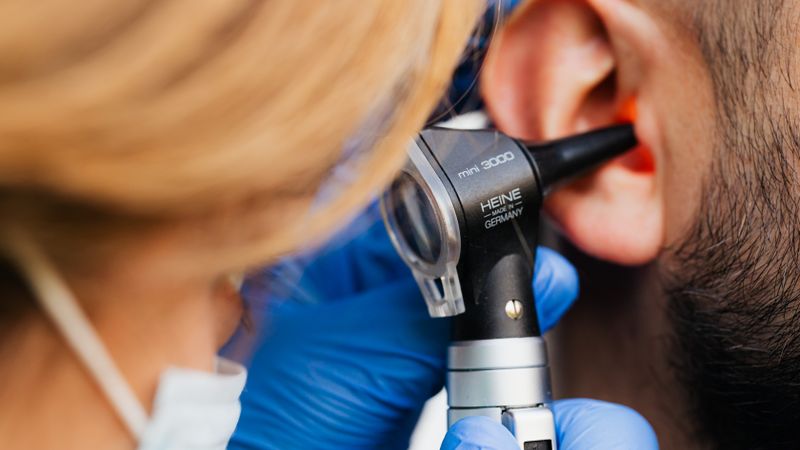
A standard hearing test takes approximately 30 minutes and is completely painless. The audiologist will examine your ears, ask about your hearing history and lifestyle, and then conduct pure-tone audiometry — a test in which you listen to tones at different frequencies and volumes through headphones and indicate when you can hear them. The results are plotted on an audiogram, which provides a detailed picture of your hearing at each frequency.
You do not need a GP referral for a private hearing test. Both NHS hearing tests (via GP referral) and private assessments are available across the UK. Many high street audiologists offer free or low-cost initial hearing checks, with full diagnostic assessments available on the same day or within the same week.
If you are unsure where to start, enter your postcode into our search tool to compare audiologists near you, check availability, and book an appointment today. The average person waits a decade before seeking help for hearing loss. That is ten years of unnecessary struggle, ten years of increased cognitive risk, and ten years of missed conversation. A 30-minute appointment could change the trajectory of your hearing health — and your overall wellbeing — for the better.