Why Workplace Noise is a Serious Public Health Issue
Every day, thousands of UK workers clock in for shifts that will, over time, permanently damage their hearing. Noise-induced hearing loss is one of the most prevalent occupational diseases in Britain, yet it remains stubbornly underreported and widely misunderstood. Unlike a broken bone or a chemical burn, noise-induced hearing loss develops silently and gradually — often going unnoticed until the damage is already done.
The Health and Safety Executive (HSE) estimates that around 17,000 people in the UK suffer deafness, ringing in the ears, or other ear conditions caused by excessive noise at work. The Royal National Institute for Deaf People (RNID) reports that approximately 1 in 6 people in the UK live with some degree of hearing loss — and for a significant proportion of them, the cause is traceable to their working environment. The financial and human cost is enormous: billions of pounds in lost productivity, compensation claims, and healthcare expenditure, not to mention the profound personal toll on individuals and their families.
The good news is that the law is firmly on the side of workers. The UK has some of the most robust occupational noise regulations in the world, and employers have clear, legally enforceable duties to protect your hearing. Understanding those rights is the first step to exercising them.
The Legal Framework: Control of Noise at Work Regulations 2005
The cornerstone of UK workplace hearing protection law is the Control of Noise at Work Regulations 2005, which came into force on 6 April 2006 for most industries. These regulations implement the European Physical Agents (Noise) Directive and place a series of specific obligations on employers based on the noise levels their workers are exposed to.
The regulations define three critical action levels, measured in decibels averaged over a working day or week (dB(A)), along with a peak sound pressure level for instantaneous noise events:
- Lower Exposure Action Values (LEAVs): 80 dB(A) daily or weekly average, or 135 dB(C) peak. At this level, employers must make hearing protection available and provide information and training to workers.
- Upper Exposure Action Values (UEAVs): 85 dB(A) daily or weekly average, or 137 dB(C) peak. At this level, employers must take active steps to reduce noise exposure, enforce the use of hearing protectors, and designate areas as Hearing Protection Zones.
- Exposure Limit Values (ELVs): 87 dB(A) daily or weekly average, or 140 dB(C) peak. These are absolute limits — workers must never be exposed beyond these levels, even when wearing hearing protection.
To put those numbers in context: a normal conversation sits around 60 dB, a busy road around 75 dB, and a pneumatic drill at close range can exceed 100 dB. In environments like construction sites, nightclubs, and manufacturing floors, it is entirely common for ambient noise to breach the upper exposure action values without any obvious warning signs. The HSE provides a noise exposure calculator and a range of sector-specific guidance to help employers — and workers — assess risk accurately.
Importantly, the regulations apply to all workers, including part-time employees, agency workers, and self-employed contractors. If noise is a hazard at your workplace, you are protected regardless of your employment status.
What Your Employer Must Do: Specific Legal Duties
The 2005 Regulations are not merely advisory — they impose concrete, enforceable duties. Where noise exposure meets or exceeds the lower exposure action values, employers are legally required to:
- Carry out a noise risk assessment to identify who is at risk and how significant that risk is. This assessment must be conducted by a competent person and reviewed regularly, or whenever working conditions change.
- Take action to reduce noise at source. The hierarchy of control is clear: before reaching for earplugs, employers must first consider engineering controls. Can quieter machinery be purchased? Can noisy processes be enclosed, isolated, or automated? Can workers be removed from noisy areas through job rotation or remote operation?
- Provide suitable hearing protection at the lower action value and ensure its use at the upper action value. There is an important legal distinction here: at 80 dB(A), you must be offered protection; at 85 dB(A), you must use it.
- Establish and sign Hearing Protection Zones wherever noise regularly reaches the upper action values. Entry into these zones without adequate hearing protection is a breach of the regulations.
- Provide workers with information, instruction, and training about the risks, the legal framework, how to use PPE correctly, and how to report concerns.
- Provide access to health surveillance where there is a risk to health — see the section on audiometric testing below.
Failure to comply with these duties can result in prohibition or improvement notices from the HSE, prosecution, unlimited fines, and civil liability for compensation claims. Since the landmark House of Lords ruling in Baker v Quantum Clothing Group [2011], case law has further shaped employer liability for historical noise exposure, making it clear that the courts take a dim view of organisations that failed to act on well-established risks.
High-Risk Industries: Are You in the Danger Zone?
While excessive noise can occur in almost any workplace, certain industries carry a disproportionately high risk. The HSE identifies the following sectors as particularly hazardous:
- Construction and demolition: Drilling, piling, breaking, and heavy plant machinery routinely exceed 90–100 dB(A). Workers in this sector are among the most at risk in the UK.
- Manufacturing and engineering: Metal fabrication, pressing, stamping, and grinding create intense, sustained noise. Older industrial sites may lack modern acoustic engineering controls.
- Music and entertainment: DJs, live musicians, bar and club staff, and sound engineers are all exposed to high levels of recreational noise — which is no less damaging for being enjoyable. The Music Industry Hearing Health (MIHH) group estimates that professional musicians are nearly four times more likely to develop noise-induced hearing loss than the general population.
- Agriculture: Tractors, chainsaws, and grain dryers are significant noise sources. Rural settings can create a false sense of security — the countryside is not inherently quiet when farm machinery is running.
- Transportation and logistics: Freight lorry drivers, airport ground crew, and rail workers face sustained or impulsive noise throughout their shifts.
- Healthcare and education: While not traditionally thought of as noisy environments, operating theatres, school classrooms, and dental surgeries can all generate sustained noise levels that accumulate over a career.
- Armed forces: Military personnel face unique and extreme noise exposures from firearms, explosives, and aircraft, with significant rates of tinnitus and hearing loss among veterans.
If you work in any of these sectors, the risk to your hearing is real and documented. Knowing your industry's specific hazard profile is essential for asserting your rights effectively.
Ready to get your hearing checked?
Enter your postcode to compare audiologists and book today.
Find appointments →Hearing Protection Equipment: What Works and What Doesn't
Hearing protection is the last line of defence in the noise control hierarchy, not the first resort — and yet in many workplaces, it remains the only measure taken. Used correctly, it can be highly effective; used incorrectly, it provides a false sense of security while noise continues to damage hearing unchecked.
Under the Personal Protective Equipment at Work Regulations 2022 (which updated and consolidated earlier PPE law), employers must supply hearing protection that is suitable for the hazard, properly fitted, maintained in good condition, and replaced when worn out. Workers, in turn, have a legal duty to use PPE properly and report any defects.
The two main categories of hearing protection in occupational settings are:
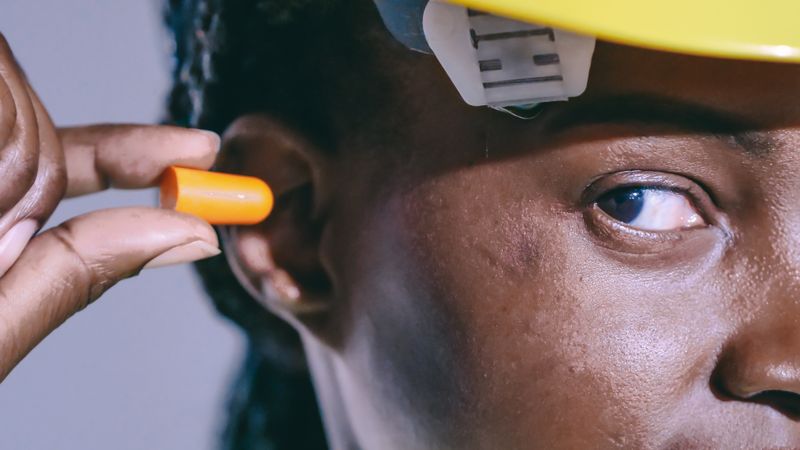
- Earplugs: Foam, pre-moulded, or custom-fitted plugs inserted into the ear canal. When correctly inserted, foam earplugs can provide 25–35 dB of attenuation. However, studies consistently show that workers frequently insert them incorrectly, dramatically reducing their effectiveness. Custom-moulded earplugs, available from audiologists, offer a superior fit and are particularly valuable for regular users.
- Earmuffs: Over-ear devices that seal around the outer ear. Generally easier to fit correctly than earplugs and suitable for workers who need to remove and replace protection frequently. Can be combined with hard hats on construction sites.
One important concept is the Single Number Rating (SNR), which indicates how much noise a hearing protector reduces in decibels. However, real-world protection is typically significantly lower than the rated SNR because of imperfect fit. The HSE recommends applying an assumed protection value that accounts for real-world wear — a precaution that many employers overlook.
For musicians and entertainment workers, standard earplugs are often unsuitable because they muffle high frequencies and distort the sound of instruments and voices. High-fidelity or flat-response earplugs are specifically designed to attenuate all frequencies equally, preserving sound quality while reducing overall volume. If you work in music or entertainment, ask your audiologist about specialist options — and consider booking a musicians' hearing test to get a detailed baseline assessment of your current hearing.
Audiometric Testing: Your Right to Regular Hearing Checks
One of the most important — and most frequently overlooked — provisions of the 2005 Regulations is the duty to provide health surveillance for workers exposed to noise at or above the lower exposure action values where there is a risk to health. In practice, this means regular occupational hearing tests, also known as audiometric testing.
Audiometric surveillance serves several critical purposes:
- It establishes a baseline hearing profile for each worker, against which future tests can be compared.
- It detects early signs of hearing loss before they become permanent and disabling.
- It identifies workers who may be particularly susceptible to noise damage and who may need enhanced protection.
- It provides data that can reveal whether existing noise controls are actually working.
- It creates a contemporaneous medical record that is crucial if a compensation claim is ever made.
The HSE recommends that initial audiometric testing should be conducted within a few weeks of starting work in a noisy environment, with follow-up tests after the first year and then at regular intervals — typically every three years for workers showing no significant change, and more frequently for those showing early signs of deterioration.
These tests must be conducted by a competent person: either a qualified occupational health professional or a doctor with relevant experience. The results are confidential between the worker and the health professional, though the employer receives an assessment of fitness for work without individual audiogram data. You have the right to see your own audiogram and to understand what it means. If your employer has not offered you hearing surveillance and you believe you are exposed to noise at or above 80 dB(A), you should raise this formally with your safety representative or HR department.
Even if your employer provides occupational testing, it is also worth arranging an independent standard hearing test to maintain your own records. Providers such as Boots Hearingcare and Specsavers Audiology offer comprehensive audiological assessments at locations across the UK, many with no referral required.
Tinnitus: The Hidden Consequence of Workplace Noise
Discussion of occupational hearing damage often focuses on measurable hearing loss — the audiogram dip that confirms nerve damage has occurred. But there is another, frequently more distressing consequence of noise exposure that deserves equal attention: tinnitus.
Tinnitus — the perception of sound (ringing, buzzing, hissing, or rushing) with no external source — affects an estimated 7.1 million adults in the UK, according to the RNID. For many people, it is a mild nuisance; for others, it is a severe and debilitating condition that disrupts sleep, concentration, mental health, and quality of life. The British Tinnitus Association (BTA) reports that around one in three people with tinnitus describe it as severely affecting their life.
Critically, tinnitus is frequently the first symptom of noise-induced hearing damage — and it can develop before a standard audiogram shows any measurable hearing loss. The phenomenon of hidden hearing loss, identified through research at the University of Cambridge and others, demonstrates that the auditory nerve can sustain significant damage that does not appear on conventional tests but produces distressing symptoms including tinnitus and difficulty understanding speech in noisy environments.
If you notice ringing in your ears after a noisy shift — even temporarily — this is a warning sign that should not be ignored. Temporary tinnitus indicates that your auditory system has been stressed; repeated episodes cause cumulative, permanent damage. Raising the issue with your employer, consulting your GP, and booking a hearing assessment with a qualified audiologist are all steps you should take promptly. The HSE guidance is clear: tinnitus that arises from or is worsened by work is an occupational health condition and your employer has a duty to address it.
Asserting Your Rights: What to Do If Your Employer Fails to Protect You
Understanding your legal rights is only useful if you know how to exercise them. If you believe your employer is not meeting their obligations under the Control of Noise at Work Regulations 2005, there are several avenues available to you.
- Raise it internally first. Speak to your line manager, safety officer, or HR department. Document everything in writing. If your workplace has a trade union, involve your health and safety representative — they have legal rights to inspect, investigate, and negotiate on your behalf.
- Contact the HSE. The Health and Safety Executive investigates complaints about unsafe working conditions. You can report a concern online at hse.gov.uk and, importantly, you are protected from dismissal or detriment for making such a report under the Employment Rights Act 1996 (whistleblowing provisions). The HSE has powers to issue enforcement notices, prohibit dangerous practices, and prosecute employers.
- Seek legal advice. If you have already suffered hearing loss or tinnitus, you may have a personal injury claim against your employer. Many specialist solicitors offer no-win, no-fee arrangements for industrial disease claims. Evidence of your employer's failure to risk-assess, provide PPE, or offer health surveillance will significantly strengthen your case. Audiometric records — both occupational and independent — are invaluable here.
- Claim Industrial Injuries Disablement Benefit (IIDB). If you have developed occupational deafness — defined as a sensorineural hearing loss of at least 50 dB in both ears, caused by exposure to occupational noise — you may be entitled to IIDB from the Department for Work and Pensions (DWP). This is a no-fault benefit; you do not need to prove your employer was negligent.
The most powerful thing you can do, both for yourself and for your colleagues, is to take your hearing health seriously before problems arise. Regular monitoring, proactive use of PPE, and engagement with your employer's noise management processes are all far preferable to the long, difficult road of managing established hearing loss or pursuing a compensation claim years after the damage has been done.
For comprehensive guidance on protecting your hearing beyond the workplace, visit our complete guide to protecting your hearing. And whether you are due for a routine check or concerned about symptoms, use our hearing appointment search to find a qualified audiologist near you today.